One-on-One with Kinesiologist Robyn Lotz

Insomnia: The Holistic Health Approach

Diatomaceous Earth: Mother Nature’s Best-Kept Secret

Robyn Lotz is a well-established kinesiologist from Cape Town who is proud to be able to call her passion her job. We sat down with her to chat about her journey & discovering kinesiology.
What made you want to pursue Kinesiology as a career?
I must have been about 23 or 24 years old, and was pretty burnt-out. My mom made an appointment with a lady called Val Hubert, who had been to study in America and had come back a whole lot of know-how and experience. So I went to her for a balance and I was in awe – I couldn’t believe that she knew exactly what was wrong with me.
After that I got married and had my first child, Jenna, who was born with severe colic and would just cry all the time. It was at this point that my sister and I decided we would look into a part-time Touch for Health Course. I realised that having this knowledge would really help my daughter, and this inspired me to pursue kinesiology and Touch for Health further.
It was somewhat daunting because I knew this was something I wanted to pursue, but at the time I had a very comfortable corporate job. Energetic work like kinesiology is a lot more accepted and widely understood now than it was back then, so this was a big leap of faith. I took it, and started training in 1991 and in 1993 I became a qualified Touch for Health instructor. I’m a kinaesthetic person and love working with my hands and helping others, so for me it was the perfect job that combined these elements really nicely.
What sets kinesiology apart from other health & healing practices?
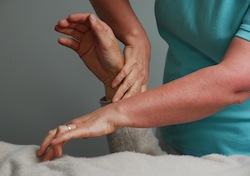
As a kinesiologist, you’re just a facilitator. As a facilitator, you tap into the body’s genetic intelligence. The body is remarkably intelligent and contains a memory or record of everything that has happened to it since conception – emotional, physical, mental – a good kinesiologist can tap into this record and facilitate healing by showing the person what their body needs or what they need to do to promote their own wellbeing.
We see the complete picture without judgment and then facilitate healing. By doing that, and by by-passing the person’s ego (like avoiding their own verbalisation of what they perceive the problem to be) you can get extremely accurate results and pinpoint exactly where the healing needs to take place. The body gives you an honest answer.
In kinesiology we work with priorities only. If you come to me with a sore finger but the heart comes up as an issue, we deal with the heart, which is asking for attention. Until the root issue is solved, the external problems can’t be attended to. When the root issue is addressed, the rest falls into place.
Kinesiologists are also quite unique in that they aren’t in competition with each other – each practitioner has their own approach and unique set of skills and gifts.
Who would you recommend kinesiology to?
The great thing about kinesiology is that it’s suitable for all age-groups, from 2 week-old babies to and 80-year-old man or woman! Kinesiology is even great for pregnant woman – it’s for everyone really…In my practice I tend to attract A-type personalities who are burnt-out, people with learning problems and people dealing with grief. These are all things I’ve been through and feel knowledgeable about and as a result seem to draw that in. I love working with woman specifically, especially those who are looking to empower themselves and who are delving through the same issues I’m familiar with.

If you had to explain what you do to someone who had never heard of kinesiology before, how would you describe it?
Kinesiology is the study of movement. Kinesiologists study the movement of a muscle in relation to an issue. Using muscle monitoring to identify imbalances in the body-mind system. And anyone can do it, but sometimes when people are too deeply entangled in their own problems they need someone to facilitate rather than measuring themselves. Dr Helen Muir refers to kinesiology as ‘psychology for sissies’ (laughs), which I suppose is another way of looking at it.